
Taxonomy
All Materials © Cmassengale

Carolus Linnaeus
Taxonomy – study of classifying organisms
- Taxonomists are scientists who study classifying
- Taxon ( taxa-plural) is a category into which related organisms are placed
Reasons to Classify:
- Shows evolutionary relationships
- Accurately & uniformly names organisms
- Prevents misnomers such as starfish & jellyfish that aren’t really fish
- Uses same language (Latin) for all names
- Prevents duplicated names because all names must be approved by International Naming Congresses (International Zoological Congress)
- Naming rules are followed called the International Code for Binomial Nomenclature
Early Taxonomy:
- Aristotle was the first taxonomist dividing organisms into land, sea, & air dwellers
- John Ray was the first to use Latin for naming
- Linnaeus developed the modern system of naming known as binomial nomenclature, a two-word name (Genus & species)
- Scientific names should be italicized in print or underlined when writing
- Always capitalize the genus name, but write the species in lower case
- The scientific name for man is Homo sapiens
- The genus name may be abbreviated, but not the species (H. sapiens)
Taxonomic categories:
- Linnaeus placed organisms into related groups called taxa (taxon-singular) based on their morphology (similar structure & function)
- The broadest taxon is called the kingdom
- Linnaeus put all organisms into one of two kingdoms — Plantae or Animalia
- The other six taxa from broadest to most specific are — Phylum, Class, Order, Family, Genus, & species
- A sentence to help remember these taxa is — “King Phillip Came Over For Gooseberry Soup.”
- Each taxa is a proper noun &should be capitalized except species
- Each level or taxon groups together organisms that share more characteristics than the level above

- Botanists use the term division instead of phylum for classifying plants
- Plant species are subdivided into varieties, while bacteria are subdivided into strains
Basis for Modern taxonomy:
- Modern taxonomists classify organisms based on their evolutionary relationships
- Homologous structures have the same structure, but different functions & show common ancestry
- The bones in a bat’s wing, human’s arm, penguin’s flipper are the same (homologous), but the function is different

- Analogous structures have the same function, but different structures & do not show a close relationship (insect wing & bird’s wing)
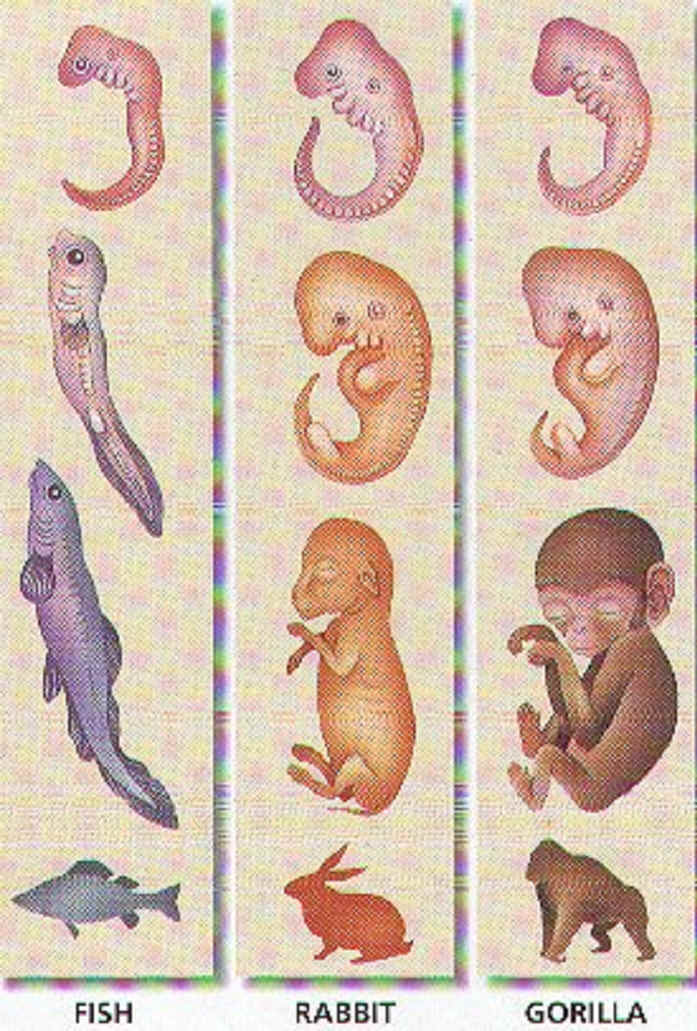
- Similarity in embryo development shows a close relationship (vertebrate embryos all have tail & gill slits)
- Similarity in DNA & amino acid sequences of proteins show related organisms
Modern Taxonomic System:
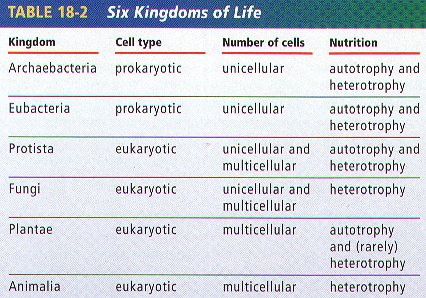
- Modern taxonomy uses six kingdoms — Archaebacteria, Eubacteria, Protista, Fungi, Plantae, & Animalia
- Archaebacteria & Eubacteria are unicellular prokaryotes lacking a nucleus, while Protista, Fungi, Plantae, & Animalia are all eukaryotes with a nucleus & membrane-bound organelles
- All members of Plantae & Animalia are multicellular organisms
- Fungi & Animalia are heterotrophs, while Plantae are all autotrophs capable of making their own food
- Archaebacteria live in harsh environments like very salty lakes; intestines of mammals; and hot, sulfur springs & may be autotrophs or heterotrophs
- Eubacteria are true bacteria some of which cause disease
- Protista are mainly unicellular with a few multicellular organisms and may be autotrophic (Euglena) or heterotrophic (Ameba)
- Fungi include multicellular mushrooms, mold, unicellular yeast, etc. & are absorptive heterotrophs (digest food & then absorb it)
- Animalia are ingestive heterotrophs that take in food & then digest it inside their multicellular bodies.
- Plantae includes all plants & are the only all multicellular, autotrophic kingdom
Phylogeny (evolutionary history):
- Phylogenetic trees are branching diagrams showing how organisms are related
- Also called family trees
- Fossil records help establish relationships on a phylogenetic tree
- Organizes living things based on their evolution (systematics)
- Common ancestor is shown at the base of the tree
- Most modern organisms shown at tips of branches
- Each time a branch divides into a smaller branch, a new species evolves

- Cladograms shows how organisms are related based on shared, derived characteristics such as feathers, hair, scales, etc.

Three Domain System:
- Based on comparing sequences of ribosomal RNA in different organisms to determine ancestry
- All organisms placed into three broad groups called domains
- Domain Archaea (kingdom Archaebacteria) contains chemosynthetic bacteria living in harsh environments
- Domain Bacteria (kingdom Eubacteria) contains all other bacteria including those causing disease
- Domain Eukarya (kingdoms Protista, Fungi, Plantae, & Animalia) contains all eukaryotic organisms
