
| Planarian Regeneration |
Lab Objective
When a brown planarian’s body part is lost or damaged, the planarian will regenerate a new body part to replace the lost one.
Planarian Background
The brown planarian is the Dugesia tigrina. It is in the class Turbellaria, which is in the phylum Platyhelminthes. The freshwater Tubellarians are found in almost all aquatic habitats. Planarians hide under rocks, leaves, and debris to avoid light. Planarians have no definite eyes, just eyespots that cannot form an image and are sensitive to light. Planarians are known as triciads because of their triple gut with a single anterior and two posterior branches. Planarians reproduce both sexually and asexually. In sexual reproduction they produce “summer” eggs, which are thin-shelled and transparent; and “winter” eggs, which are usually black and set on stalks. Planarians are hermaphroditic, possessing complete male and female systems. They produce asexually by fragmentation and tail dropping in which they spontaneously drop their tails and each end regenerates the missing part. Planarians are carnivorous eating both living and dead organic matter. Kept in captivity, they feed on raw liver.
Lab Materials
Materials used in the lab include two petri dishes, a pencil, paper, two planarians, a microscope slide, lens paper, scalpel, dropper/pipette, magnifying glass, camel’s hair brush, ruler, scissors, tape, raw data folder, and aged water.
Lab Procedure
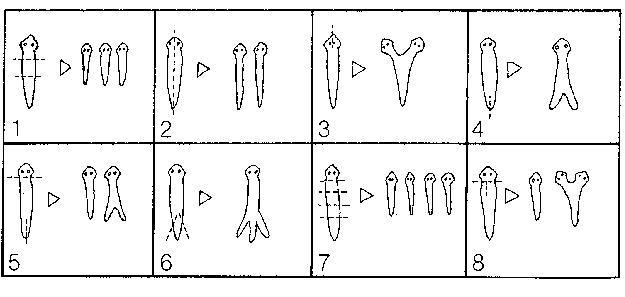
Choose two cuts from the eight operations given. (Figure 1) Record your name & the number of the cut on a label and tape this on the underside of the petri dish so it is visible from the top. Repeat this procedure with the second cut & dish. Fill both dishes with aged water. Next, choose two planarians and measure the length and width of each worm and record this in your data folder. Prepare an “operating table” by wrapping lens paper around a microscope slide. Using a camel’s hair brush, transfer a planarian from the petri dish to the operating table. Allow the planarian to become fully extended on the slide, but do not let it dry out. When the planarian is fully extended, make the chosen cut quickly and cleanly. When the operation is complete, rinse the pieces of planarian into the petri dish with a stream of aged water from the dropper. Replace the lids on the petri dish and place in a shaded area at room temperature. Repeat with the second cut. During the regeneration process, do not feed the planarians, and they should not be disturbed as little as possible.
* Because planarians foul their water quickly, it is necessary to change their water twice a week by pipetteing the old water out and replacing with new aged water. It will also be necessary to oxygenate the water by blowing bubbles in the water with the dropper.
Figure 1
Data
* Cut one is a transverse cut, while cut two is a longitudinal cut.
Table 1
| CUT ONE | Length | Width | Number of Pieces | Other |
| Day 1 | 10 mm | 2mm | 3 | |
| Day 2 | 3mm each | 1mm each | 4 | Head part moving, others floating |
| Day 6 | 3mm each | 1mm each | 4 | Tail dropped on one piece |
| Day 8 | 3mm each | 1mm each | 4 | Slight growth |
| Day 13 | 3mm each | 1mm each | 4 | Water changed & oxygenated |
| Day14 | 3mm each | 1mm each | 4 | Vast regeneration, all part moving, transparent in color in some areas |
Table 2
| CUT TWO | Length | Width | Number of Pieces | Other |
| Day 1 | 9mm | 2mm | 2 | Both tails dropped |
| Day 2 | 4mm each | 1mm each | 1 | 1 piece disintegrated |
| Day 6 | 0 | 0 | 0 | Total disintegrated/ new cut |
| Day 8 | 3mm & 4mm | 1mm & 1mm | 2 | Slight growth |
| Day 13 | 3mm & 4mm | 1mm & 1mm | 2 | Slight growth |
| Day14 | 3mm & 4mm | 1mm & 1mm | 2 | Definite movement |
Error Analysis
Some tail dropping occurred & some pieces were so small that they disintegrated instead of regenerating
Conclusion
It can be concluded that when a planarian loses or damages a body part, it will regenerate over a certain period of time into a whole new planarian. There are some conditions that may occur during the regeneration process. For instance, the tail end of a headpiece grows faster, and the eyes first begin to appear about a week into the lab. Between the eyes and pharynx, the pharynx regenerates faster. While the rest of the body is brown, the regenerated areas are transparent and also show polarity.