Photosynthesis
All Materials © Cmassengale

I. Capturing the Energy of Life
- All organisms require energy
- Some organisms (autotrophs) obtain energy directly from the sun and store it in organic compounds (glucose) during a process called photosynthesis
6CO2 + 6H2O + energy –> 6O2 + C6H12O6
II. Energy for Life Processes
- Energy is the ability to do work
- Work for a cell includes growth & repair, active transport across cell membranes, reproduction, synthesis of cellular products, etc.
- Work is the ability to change or move matter against other forces (W = F x D)
- Autotrophs or producers convert sunlight, CO2, and H2O into glucose (their food)
- Plants, algae, and blue-green bacteria, some prokaryotes, are producers or autotrophs
- Only 10% of the Earth’s 40 million species are autotrophs
- Other autotrophs use inorganic compounds instead of sunlight to make food; process known as chemosynthesis
- Producers make food for themselves and heterotrophs or consumers that cannot make food for themselves
- Heterotrophs include animals, fungi, & some bacteria, & protists

III. Biochemical Pathways
- Photosynthesis and cellular respiration are biochemical pathways
- Biochemical pathways are a series of reactions where the product of one reaction is the reactant of the next
- Only autotrophs are capable of photosynthesis
- Both autotrophs & heterotrophs perform cellular respiration to release energy to do work
- In photosynthesis, CO2(carbon dioxide) and H2O (water) are combined to form C6H12O6 (glucose) & O2 (oxygen)
6CO2 + 6H2O + energy –> 6O2 + C6H12O6 - In cellular respiration, O2 (oxygen) is used to burn C6H12O6 (glucose) & release CO2(carbon dioxide), H2O (water), and energy
- Usable energy released in cellular respiration is called adenosine triphosphate or ATP

IV. Light Absorption in Chloroplasts
- Chloroplasts in plant & algal cells absorb light energy from the sun during the light dependent reactions
- Photosynthetic cells may have thousands of chloroplasts
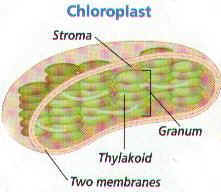
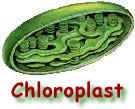
- Chloroplasts are double membrane organelles with the an inner membrane folded into disc-shaped sacs called thylakoids
- Thylakoids, containing chlorophyll and other accessory pigments, are in stacks called granum (grana, plural)
- Grana are connected to each other & surrounded by a gel-like material called stroma
- Light-capturing pigments in the grana are organized into photosystems
V. Pigments
- Light travels as waves & packets called photons
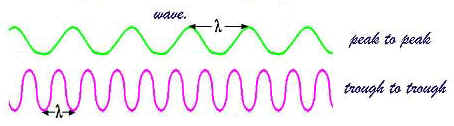
- Wavelength of light is the distance between 2 consecutive peaks or troughs
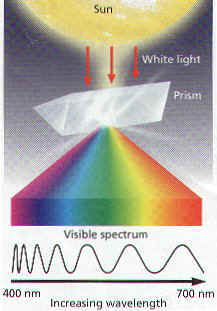
- Sunlight or white light is made of different wavelengths or colors carrying different amounts of energy
- A prism separates white light into 7 colors (red, orange, yellow, green, blue, indigo, & violet) ROY G. BIV
- These colors are called the visible spectrum
- When light strikes an object, it is absorbed, transmitted, or reflected
- When all colors are absorbed, the object appears black
- When all colors are reflected, the object appears white
- If only one color is reflected (green), the object appears that color (e.g. Chlorophyll)
| VI. Pigments in the Chloroplasts
|
 |
- Thylakoids contain a variety of pigments ( green red, orange, yellow…)
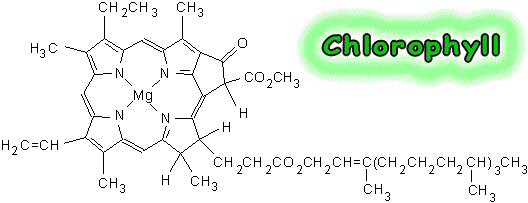
- Chlorophyll (C55H70MgN4O6) is the most common pigment in plants & algae
- Chlorophyll a & chlorophyll b are the 2 most common types of chlorophyll in autotrophs
- Chlorophyll absorbs only red, blue, & violet light
- Chlorophyll b absorbs colors or light energy NOT absorbed by chlorophyll a
- The light energy absorbed by chlorophyll b is transferred to chlorophyll a in the light reactions
- Carotenoids are accessory pigments in the thylakoids & include yellow, orange, & red

VII. Overview of Photosynthesis 6CO2 + 6H2O C6H12O6 + 6O2
- Photosynthesis is not a simple one step reaction but a biochemical pathway involving many steps
- This complex reaction can be broken down into two reaction systems — light dependent & light independent or dark reactions
- Light Reaction: H2O O2 + ATP + NADPH2
- Water is split, giving off oxygen.
- This system depends on sunlight for activation energy.
- Light is absorbed by chlorophyll a which “excites” the electrons in the chlorophyll molecule.
- Electrons are passed through a series of carriers and adenosine triphosphate or ATP (energy) is produced.
- Takes place in the thylakoids.
- Dark Reaction: ATP + NADPH2 + CO2 C6H12O6
- Carbon dioxide is split, providing carbon to make sugars.
- The ultimate product is glucose.
- While this system depends on the products from the light reactions, it does not directly require light energy.
- Includes the Calvin Cycle.
- Takes place in the stroma.

VIII. Calvin Cycle
- Carbon atoms from CO2 are bonded or “fixed” into organic compounds during a process called carbon fixation
- The energy stored in ATP and NADPH during the Light Reactions is used in the Calvin cycle
- The Calvin cycle has 3 main steps occurring within the stroma of the Chloroplast
STEP 1
- CO2 diffuses into the stroma from surrounding cytosol
- An enzyme combines a CO2 molecule with a five-carbon carbohydrate called RuBP
- The six-carbon molecule produced then splits immediately into a pair of three-carbon molecules known as PGA
STEP 2
- Each PGA molecule receives a phosphate group from a molecule of ATP
- This compound then receives a proton from NADPH and releases a phosphate group producing PGAL
- These reactions produce ADP, NADP+, and phosphate which are used again in the Light Reactions.
STEP 3
- Most PGAL is converted back to RuBP to keep the Calvin cycle going
- Some PGAL leaves the Calvin Cycle and is used to make other organic compounds including amino acids, lipids, and carbohydrates
- PGAL serves as the starting material for the synthesis of glucose and fructose
- Glucose and fructose make the disaccharide sucrose, which travels in solution to other parts of the plant (e.g., fruit, roots)
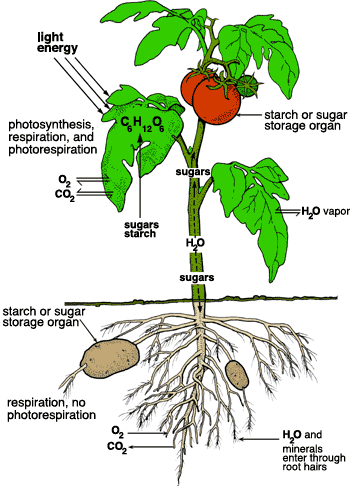
- Glucose is also the monomer used in the synthesis of the polysaccharides starch and cellulose
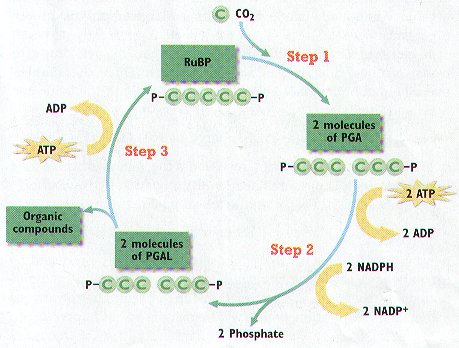
- Each turn of the Calvin cycle fixes One CO2 molecule so it takes six turns to make one molecule of glucose
IX. Photosystems & Electron Transport Chain
- Only 1 in 250 chlorophyll molecules (chlorophyll a) actually converts light energy into usable energy
- These molecules are called reaction-center chlorophyll
- The other molecules (chlorophyll b, c, & d and carotenoids) absorb light energy and deliver it to the reaction-center molecule
- These chlorophyll molecules are known as antenna pigments
- A unit of several hundred antenna pigment molecules plus a reaction center is called a photosynthetic unit or photosystem
- There are 2 types of photosystems — Photosystem I & Photosystem II
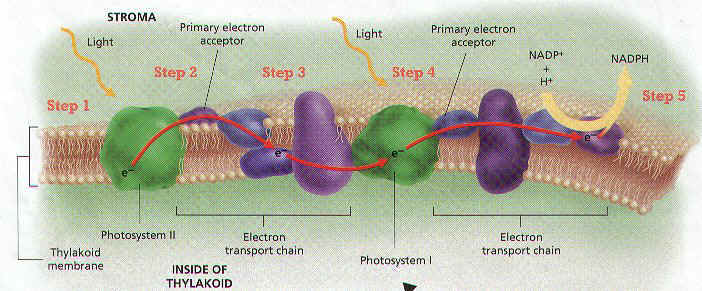
- Light is absorbed by the antenna pigments of photosystems II and I
- The absorbed energy is transferred to the reaction center pigment, P680 in photosystem II, P700 in photosystem I
- P680 in Photosystem II loses an electron and becomes positively charged so it can now split water & release electrons (2H2O 4H+ + 4e- + O2)
- Electrons from water are transferred to the cytochrome complex of Photosystem I
- These excited electrons activate P700 in photosystem I which helps reduce NADP+ to NADPH
- NADPH is used in the Calvin cycle
- Electrons from Photosystem II replace the electrons that leave chlorophyll molecules in Photosystem I
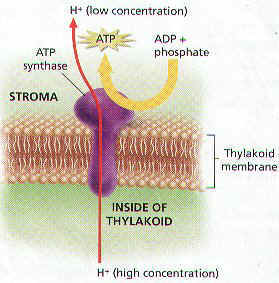
- Synthesis or making of ATP (energy)
- Depends on the concentration gradient of protons ( H+) across the thylakoid membrane
- Protons (H+) are produced from the splitting of water in Photosystem II
- Concentration of Protons is HIGHER in the thylakoid than in the stroma
- Enzyme, ATP synthetase in the thylakoid membrane, makes ATP by adding a phosphate group to ADP
XI. Alternate Pathways
- The Calvin cycle is the most common pathway used by autotrophs called C3 Plants
- Plants in hot, dry climates use alternate pathways to fix carbon & then transfer it to the Calvin cycle
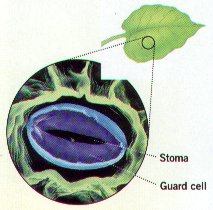
- Stomata are small openings on the underside of leaves for gas exchange (O2 & CO2)
- Guard cells on each side of the stoma help open & close the stomata
- Plants also lose H2O through stoma so they are closed during the hottest part of the day
- C4 plants fix CO2 into 4-Carbon Compounds during the hottest part of the day when their stomata are partially closed
- C4 plants include corn, sugar cane and crabgrass
- CAM plants include cactus & pineapples
- CAM plants open their stomata at night and close during the day so CO2 is fixed at night
- During the day, the CO2 is released from these compounds and enters the Calvin Cycle
XII. Factors Determining the Rate of Photosynthesis
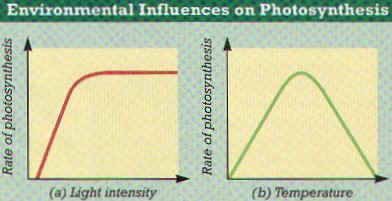
- Light intensity – As light intensity increases, the rate of photosynthesis initially increases and then levels off to a plateau
- Temperature – Only the dark, not the light reactions are temperature dependent because of the enzymes they use (25 oC to 37oC)
- Length of day
- Increasing the amount of carbon dioxide available improves the photosynthesis rate
- Level of air pollution