
Constructing a Pedigree
Introduction
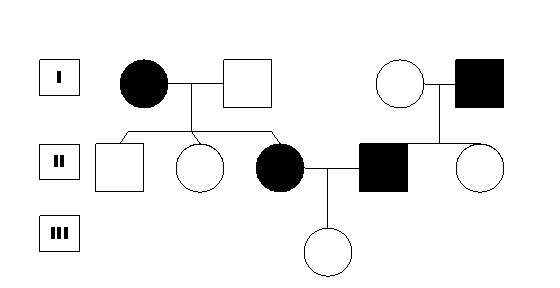
A pedigree is a special chart or family tree that uses a particular set of standardized symbols. Pedigrees are used to show the history of inherited traits through a family. In a pedigree, males are represented by squares and females by circles . An individual who exhibits the trait in question, for example, someone who suffers from hemophilia, is represented by a filled symbol or . A horizontal line between two symbols represents a mating . The offspring are connected to each other by a horizontal line above the symbols and to the parents by vertical lines. Roman numerals (I, II, III, etc.) symbolize generations. Arabic numerals (1,2,3, etc.) symbolize birth order within each generation. In this way, any individual within the pedigree can be identified by the combination of two numbers (i.e., individual II3).
Objective
Inherited traits can be traced through a family’s history by constructing a pedigree chart.
Materials
Large sheet of paper or poster board
Markers
Ruler
Protractor
Procedure
Part 1
1. Examine Figure 1 that traces the ability to roll your tongue through three generations in a family. Remember: Blackened circles show the trait and circles are females and squares are male.
2. Determine which parents and which offspring would be able to roll their tongue.
FIGURE 1
Part 2
3. Read the Passage 1 about the Smith family and their inherited trait of dimples.
4. After reading the passage, construct a pedigree showing all family members in each generation that does and does NOT have dimples.
5. Once the pedigree is constructed, write the correct genotype by each person in the family.
Passage 1
Grandfather and Grandmother Smith smiled a lot and showed off their dimples each time. They had a son named John, who had dimples, and daughter named Julie, who did not. Julie died at an early age, but her brother John Smith met and married Mary Jones because she had the most beautiful dimples when she smiled. They had 5 children, 2 boys and 3 girls. Only one of their sons, Tom, had dimples, but both girls, Judy and Kay, had dimpled smiles. Their sister June lacked dimples. After college, Tom met and married Jane Kennedy who also had dimples. They had 3 children, all girls, who shared their parent’s dimpled smile. Tom’s sister Kay married a lawyer named James who seldom smiled and didn’t have dimples. Their only son Matthew was like his mother when he smiled. Judy never married. Tom’s sister, June, married a doctor and had 5 children. Three of the children were boys, Jay, Fred, and Mike. Mike and Fred had dimples like dad, but Jay’s smile was like his mom’s lacking dimples. One sister, Susan, had dimples, but the other, Katherine, didn’t.
Questions
1. What type of information does a pedigree contain?
2. How do you show the presence of a trait in a pedigree?
3. How do you denote males & females in a pedigree?
4. From your pedigree, is the presence of dimples a dominant or recessive trait?
5. How could examining a family pedigree be helpful to a couple wanting to have children?