
Battle of the Hermaphrodites
Sexes Clash Even When Sharing the Same Body
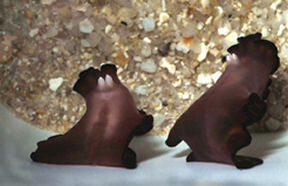 |
| DUELING FLATWORMS. Two hermaphroditic flatworms, Pseudobiceros bedfordi, each with pale, side-by-side penises, show their undersides as they square off to mate. Michiels |
Many snails, slugs, and worms are so-called internally fertilizing, simultaneous hermaphrodites. In any encounter, such creatures can deliver sperm, receive it for fertilizing eggs internally, or do both. Nico Michiels, an evolutionary ecologist at the University of Tübingen in Germany , offers the striking example of hermaphroditic polyclad flatworms called Pseudobiceros bedfordi. When two of these small, speckled sea worms meet to mate, there’s no taking turns. Each worm, 2 to 6 centimeters long, wields its pair of side-by-side penises like a weapon. One worm tries to fertilize the other by ejaculating anywhere on its partner’s body, splashing it with sperm in a cocktail that dissolves flesh. After the brew eats a hole through the skin, the sperm work their way through various tissues until they reach the eggs.
In many P. bedfordi encounters, only one member of the pair gets its sperm to the other’s eggs. The recipient of the sperm eventually deposits clutches of hundreds of eggs on some suitable surface and glides away. The holes and wrinkly streaks on many worms’ bodies are ejaculate burns, says Michiels. It’s not that the duelists could choose a less violent way to couple. In these worms, the reproductive tract has an opening, but it doesn’t lead to the eggs.
And in many other simultaneous hermaphrodites, if one partner deposited sperm into the other’s reproductive tract, elaborate plumbing would divert a sizable portion of the sperm to digestive organs, presumably as a snack for the recipient. Of course, animals with separate sexes can be rough and tumble too, says Michiels. However, he and a colleague propose that gender wars are more likely to flare into bodily harm among simultaneous-hermaphrodite species with internal fertilization than among their separate-sex counterparts.
In the violence that’s evolved in many of these simultaneous hermaphrodites, says Michiels, “the result is an almost ridiculous escalation.” The mating quirks of simultaneous hermaphrodites are attracting growing interest. Researchers are exploring the sexual conflicts that escalate into bodily harm. A few species, however, have gone in the other direction, developing systems for cooperative bouts of mutual insemination or for taking turns. From Michiels’ perspective, though, hermaphrodites “tell us it’s very useful to have the sexes separate.”
Formerly Benign
Roughly 15 percent of animal species live a hermaphroditic lifestyle of some form, Michiels estimates. Many of them are sequential hermaphrodites, such as clown fish that spend their young adulthood as one gender and then switch to the other. Among the animals that are simultaneously male and female, Michiels distinguishes between hermaphrodites where partners make contact to achieve internal fertilization and those in which at least one of the partners releases a cloud of gametes, so the partners don’t themselves make physical contact. According to Michiels, the fertilizers without partner contact are less likely to careen into a violent conflict than are hermaphrodites with full-contact internal fertilization.
For years, biologists didn’t think much about sexual conflict, even in species with separate sexes, says Nils Anthes, also of Tübingen. Mating seemed “benign,” as Anthes puts it. Both males and females have urges for offspring, so at first glance, producing youngsters should be a happy, family project.
That rosy view began fading in 1948, when fruit fly researcher Angus John Bateman of England argued that males invest much less energy in producing offspring than females do. That investment gap suggested that the best reproductive strategy for one sex isn’t equally good for the other. Bateman argued that the average male would do well to mate as widely as possible, while a female should be particular about whose sperm she accepts. What could make better tinder for conflict between the sexes?
In 1979, theorist Eric Charnov, now at the University of New Mexico in Albuquerque , proposed that these ideas could apply to simultaneous hermaphrodites. For example, conflicts could arise as individuals of those species sort out when to play each sexual role.
For years, theorists assumed that tactics in the hermaphrodite gender war would be fairly consistent within an individual or even a species, says Anthes. However, in the July Animal Behaviour, Michiels, Anthes, and Annika Putz, offer what they call a new framework for thinking about hermaphrodites. It urges theorists to compare his and hers benefits under changeable, thus realistic, conditions. Strategies could vary, for example, with the characteristics of available partners. In another paper, Michiels and Anthes report that sea slugs donate more sperm to a partner that’s been isolated than to one that’s recently mated and so already carries plenty of sperm.
Mate This
Some of the mating habits of simultaneous hermaphrodites can be difficult for humans to understand. For that reason, the University of California , Santa Cruz doesn’t emphasize that its athletic teams’ mascot, a hermaphroditic banana slug, has been reported to practice apophally, or penis biting. Theorists have proposed several dramatic hypotheses about the conflicted sex lives of the big, land-living, bright-yellow slugs. One focused on the possible value of a detached organ as a barrier to the recipient mating with others.
Heike Reise of the State Museum of Natural History in Görlitz , Germany , suggests something simpler: The worms just get stuck. The reproductive-tract muscles may sometimes grip its partner’s penis too tenaciously. This would explain reports of slugs appearing to strain apart before one bites off its partner’s penis.
These and other hermaphroditic matings that look like maulings have inspired many scientific publications in recent years. Michiels and Leslie Newman described in 1998 what has become a classic example, called penis fencing, in the Pseudoceros bifurcus marine worm from Australia ‘s Great Barrier Reef . When potential mates meet, they rear up and face off, feinting and dodging.
The researchers argued that each worm was trying to fertilize the other’s eggs while minimizing the sperm it receives. A worm delivers its sperm by using its penis to punch a hole in the partner’s skin, anywhere on the body. As in the ejaculate-splashing polyclad worms, the sperm’s navigational prowess gets it to the eggs. Since 1998, the scientists have found relatives of P. bifurcus that mate even more aggressively, says Michiels.
“Everybody wants to be male, and nobody wants to be female,” is Michiels’ basic explanation. The species keep evolving tactics, some of them violent, to maximize fatherhood. Michiels and Joris Koene of the Free University in Amsterdam present a mathematical model in the August Integrative and Comparative Biology predicting that hermaphrodite species face an extra-high risk of evolving violence between mates.
If the species had separate sexes, females would act as a safety brake, says Michiels. When the male function starts taking a big toll on female reproduction, females take countermeasures. But that doesn’t happen when each individual is both male and female. To Michiels, the prospects for creatures living this way look so perilous that he speculates that they’re headed for “an evolutionary dead end.”
Doping scandals
Some hermaphrodites have a literal take on Cupid’s arrows. The common brown garden snail (Cantareus aspersus) and members of at least four families of land snails shoot what’s popularly called a love dart.
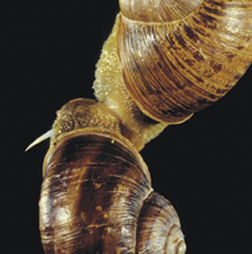 |
| IT MUST BE LOVE. The sharp calcium spike stuck through the head of the common garden snail on the left was launched during courtship by its mating partner.
Chase & Koene |
Over some 7 days, a garden snail forms a 9-millimeter-long, sharpened shaft in a gland near the opening of its reproductive tract. As two snails wriggle around, positioning themselves to pump sperm into the reproductive tract of each other, each launches its dart toward each other’s body.
“It’s a strange thing to do to your prospective mate,” notes neurobiologist Ronald Chase of McGill University in Montreal .
Chase got curious about the snails’ darts in the 1980s. The prevailing explanation at the time, he says, had been floating around since the early 18th century: The dart would make the partner more willing to mate.
That explanation was “easy to refute,” says Chase. First, virgin snails don’t shoot a dart when they first mate, and other snails flub the shot about half the time. They either botch the launch so that the dart bounces off the partner without embedding or they miss the partner entirely. In various studies, he and a colleague compared aspects of mating, for example, the length of time that the snails courted before copulating, when snails mated with and without dart piercing. “It made absolutely no difference,” he says.
Having undermined the previous explanation of the dart, Chase began seeking others. He found that snails triumphing at the dart thrust gained an advantage. They sired twice as many offspring as did snails whose darts missed their targets.
Among garden snails, a sticky substance coats the darts, and Chase and a series of collaborators have experimented to see whether the darts deliver some mate-managing chemical. When researchers dissected out snail reproductive ducts that receive sperm and smeared them with dart mucus, the ducts began contracting in ways that Chase speculates would send sperm toward the storage organs on the route to fertilization rather than toward a gland that digests sperm.
These findings suggested that darts deliver snail drugs, but Chase still wondered whether the stabbing itself had an effect. Chase’s McGill colleague Katrina Blanchard has just ruled out that possibility. She removed the dart-making gland and its contents from about 200 garden snails. When these snails mated, she did the stabbing herself, using a syringe to inject either a saline solution or an extract of dart goo. The stabbing and saline injection didn’t boost paternity, but a shot of dart goo did, Chase and Blanchard report in the June 22 Proceedings of the Royal Society B.
Garden snails do well if they make one jab, but other species hold on to their love darts and wield them as daggers. A Japanese hermaphroditic snail stabs its partner some 3,000 times during a single mating encounter, report Koene and Satoshi Chiba of Tohoku University in Sendai , Japan . In work released online for the October American Naturalist, the researchers say that the pattern of darts and daggers throughout the snail family tree shows that among hermaphroditic species, repeated stabbing probably evolved before single-use darts did.
Koene has used dart-stabber family trees to look for evidence of arms-race escalation in sexual traits. He and Hinrich Schulenburg of Tübingen found that among Helicoidea snails, two traits tend to occur in the same species. Fancified darts with flanges deliver extra goo, and elongated sperm-receiving organs diminish the goo’s power by requiring it to act on a greater area of tissue. That pairing looks like the aftermath of escalating conflict, the researchers argued in the March 30, 2005 BMC Evolutionary Biology.
Although the examples are striking, Chase says that he’s not convinced that the males’ and females’ interests clash. Chase and his McGill colleague Kristin Vaga reported in the April Behavioral Ecology and Sociobiology that they haven’t found clear behavioral signs of conflict, such as avoidance, in the mating of garden snails.
Until now, snail love darts have dominated research on mate-controlling chemicals. But other structures are now being considered. A study of common earthworms (Lumbricus terrestris), which are simultaneous hermaphrodites, has found that some 30 of each individual’s 40 special hairs pierce its partner’s skin, according to Koene, Michiels, and Tina Pförtner of Westfaelische Wilhelms University in Münster, Germany. These hair stabs change the partner’s uptake of sperm, possibly by injecting chemicals, the team reported in the December 2005 Behavioral Ecology and Sociobiology.
Anthes is working with the sea slug Siphopteron quadrispinosum. Its penis has an attached stylet that plunges into a partner’s body during mating. The slug taking the hit slows down, so Anthes speculates that the syringelike prong injects a sedative.
Although many simultaneous hermaphrodites play the guy’s role more aggressively than the girl’s, Michiels notes that in a few cases the sperm receiver seems to take charge. He’s found early–20th-century accounts of a rare freshwater European flatworm without a functional penis. Instead, according to the reports, the individual acting as a female thrusts a faux penis into its partner and draws out a supply of sperm.
Equal Partners?
Sex isn’t all conflict, though. Some hermaphrodites take turns being male and female or simultaneously deliver and receive sperm. Scientists had proposed that one partner might become more or less cooperative depending on what the other one just did. Anthes and Michiels have come up with a new method for testing this idea. They studied a “very beautiful” sea slug that’s a simultaneous hermaphrodite, says Anthes.
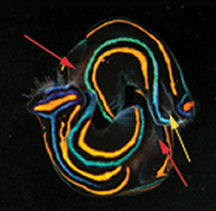 |
| FAIR TRADE. Two hermaphroditic Chelidonura hirundinina sea slugs prepare for one of several simultaneous sperm exchanges. (Red arrows indicate female openings; yellow arrow shows male organs.) Anthes & Michiels |
Yellow and blue lines shimmer along the black body of Chelidonura hirundinina, but what the researchers find even more beautiful is a little fold of skin lined with hairs that guide blobs of sperm from a worm’s testes along a brief trip in the outside world to its penis. The researchers cauterized the groove in a few worms so that sperm wouldn’t reach the penis.
Mating slugs normally exchange some sperm, back off, and then return for another round. They reciprocally transfer sperm five to eight times during a mating. When researchers cauterized the sperm-guiding groove of one slug, so that it no longer provided sperm, the partner broke off the exchanges after only two to four rounds, the researchers reported in the Oct. 11, 2005 Current Biology.
When the researchers have tried the experiment in another species, Chelidonura sandrana, cauterization produced no change in mating. That might have been a disappointment, but Michiels says that the difference between the two species might hold clues to the value of reciprocity.
Such unexpected twists, Michiels says, attracted him to the study of hermaphrodites. “I really had the feeling that we know about males and females,” he says. For hermaphrodites, though, “it’s a completely different world.”

Citation:
Michiels, Nico. “Battle of the Hermaphrodites”. Science News. Sept. 16, 2006; Vol. 170, No. 12.