
Echinoderms
All Materials © Cmassengale
Phylum Echinodermata
Characteristics
- All marine
- Known as spiny-skinned animals
- Endoskeleton known as the test is made of calcium plates or ossicles with protruding spines
- Includes sea stars, brittle stars, sand dollars, sea urchins, & sea cucumbers
- Undergo metamorphosis from bilateral, free-swimming larva to sessile or sedentary adult
- Larval stage known as dipleurula or bipinnaria
- Adults have pentaradial ( 5 part) symmetry
- Lack segmentation or metamerism
- Coelomate
- Breathe through skin gills as adults
- Capable of extensive regeneration
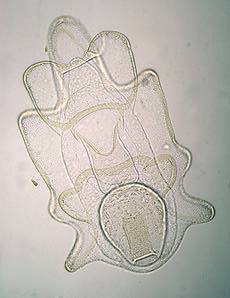
Bipinnaria Larva
- Ventral (lower) surface called the oral surface & where mouth is located
- Dorsal (upper) surface known as aboral surface & where anus is located
- Have a nervous system but no head or brain in adults
- No circulatory, respiratory, or excretory systems
- Have a network of water-filled canals called the water vascular system to help move & feed
- Tube feet on the underside of arms help in moving & feeding
- One-way digestive system consists of mouth with oral spines, gut, & anus
- Deuterostomes (blastopore becomes the anus)
- Separate sexes
- Reproduce sexually & asexually
- Includes 5 classes:
* Crinoidea – sea lilies & feather stars
* Asteriodea – starfish
* Ophiuroidea – basket stars & brittle stars
* Echinoidea – sea urchins & sand dollars
* Holothuroidea – sea cucumbers
Class Crinoidea
Characteristics
- Sessile
- Sea lilies & feather stars
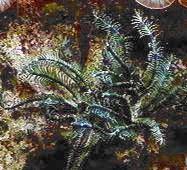 FEATHER STAR |
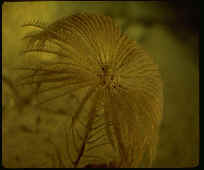 SEA LILY |
- Have a long stalk with branching arms that attach them to rocks & the ocean bottom
- Can detach & move around
- Mouth & anus on upper surface
- May have 5 to 200 arms with sticky tube feet to help capture food (filter feeders) & take in oxygen
- Common in areas with strong currents & usually nocturnal feeders
Class Asteroidea
Characteristics
- Usually sedentary along shorelines
- Starfish or sea stars
- Come in a variety of colors
- Prey on bivalve mollusks such as clams & oysters

Starfish Feeding on Clam
- Have 5 arms that can be regenerated
- Arms project from the central disk
- Mouth on oral surface (underside)
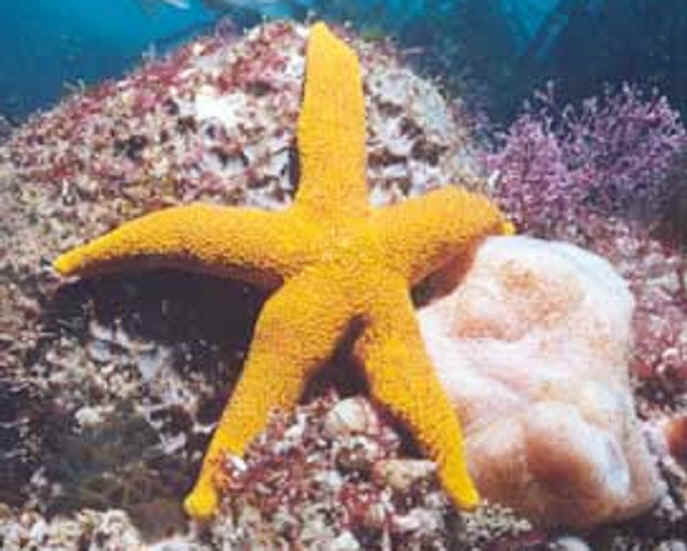
STARFISH
Class Ophiuroidea
Characteristics
- Largest class of echinoderms
- Includes basket stars & brittle stars
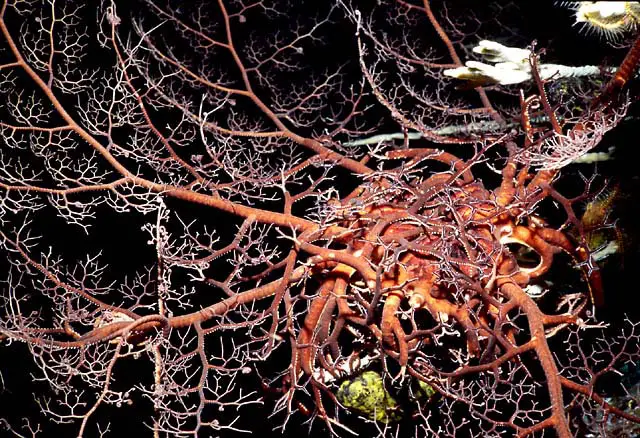 BASKET STAR |
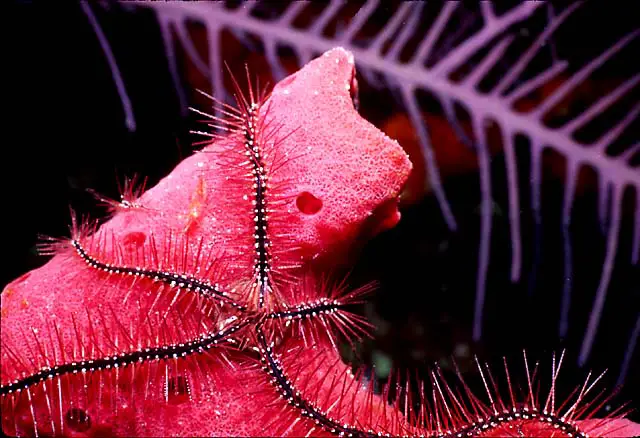 BRITTLE STAR |
- Live on the ocean bottom beneath stones, in crevices, or in holes
- Have long, narrow arms resembling a tangle of snakes
- Arms readily break off & regenerate
- Move quicker than starfish
- Feed by raking in food with arms or trapping it with its tube feet
Class Echinoidea
Characteristics
- Includes sea urchins & sand dollars
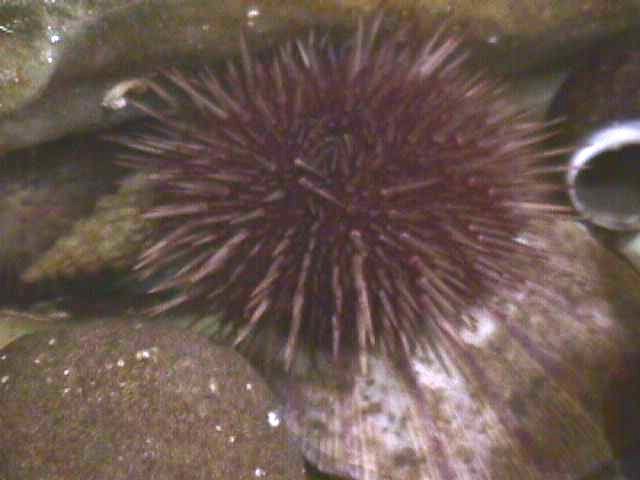 SEA URCHIN |
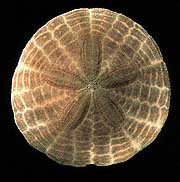 SAND DOLLAR |
- Internal organs enclosed by endoskeleton or test made of fused skeletal plates
- Body shaped like a sphere (sea urchin) or a flattened disk (sand dollar)
- Lack arms
- Bodies covered with movable spines
- Have a jawlike, crushing structure called Aristotle’s lantern to grind food
- Use tube feet to move
- Sea Urchins:
* Spherical shape
* Live on ocean bottom
* Scrape algae to feed
* Long, barbed spines make venom for protection - Sand Dollars:
* Flattened body
* Live in sand along coastlines
* Shallow burrowers
* Have short spines
Class Holothuroidea
Characteristics
- Includes sea cucumber
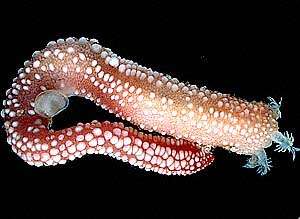
SEA CUCUMBER
- Lack arms
- Shaped like a pickle or cucumber
- Live on ocean bottoms hiding in caves during the day
- Have a soft body with a tough, leathery outer skin
- Five rows of tube feet run lengthwise on the aboral (top) surface of the body
- Have a fringe of tentacles (modified tube feet) surrounding the mouth to sweep in food & water
- Tentacles have sticky ends to collect plankton
- Show bilateral symmetry
- Can eject parts of their internal organs (evisceration) to scare predators; regenerate these structures in days
Structure & Function of Starfish
Body Plan
- Range in size from 1 centimeter to 1 meter
- Mouth located on oral surface (underside)
- Have an endoskeleton made of calcium plates
- Sharp, protective spines made of calcium plates called ossicles found under the skin on the aboral (top) surface
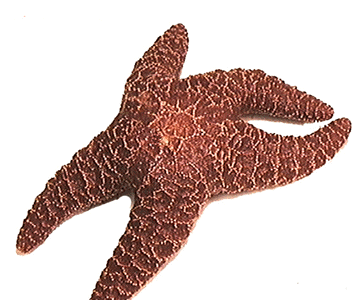
ABORAL SURFACE
- Have pedicellariae or tiny, forcep-like structures surrounding their spines to help clean the body surface
Water Vascular System
- Network of canals creating hydrostatic pressure to help the starfish move

WATER VASCULAR SYSTEM
- Water enters through sieve plate or madreporite on aboral surface into a short, straight stone canal
- Stone canal connects to a circular canal around the mouth called the ring canal
- Five radial canals extend down each arm & are connected to the ring canal
- Radial canals carry water to hundreds of paired tube feet
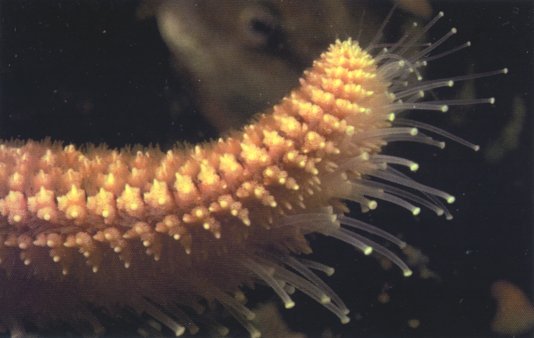
TUBE FEET
- Bulb-like sacs or ampulla on the upper end of each tube foot contract & create suction to help move, attach, or open bivalves
- Rows of tube feet on oral surface (underside) are found in ambulcaral grooves under each arm
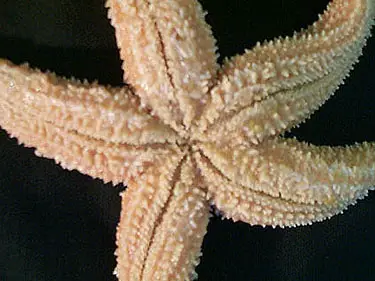
Tube Feet in Ambulcaral Grooves
Feeding & Digestion
- Tube feet attach to bivalve mollusk shells & create suction to pull valves apart slightly
- Starfish everts (turns inside out) its stomach through its mouth & inserts it into prey
- Stomach secretes enzymes to partially digest bivalve then stomach withdrawn & digestion completed inside starfish
Other Body Systems
- No circulatory, excretory, or respiratory systems
- Coelomic fluid bathes organs & distributes food & oxygen
- Gas exchange occurs through skin gills & diffusion into the tube feet
- No head or brain
- Have a nerve ring surrounding the mouth that branch into nerve cords down each arm
- Eyespots on the tips of each arm detect light
- Tube feet respond to touch
Reproduction
- Separate sexes
- Two gonads (ovaries or testes) in each arm produce eggs or sperm
- Have external fertilization
- Females produce up to 200,000,000 eggs per season
- Fertilized eggs hatch into bipinnaria larva which settles to the bottom after 2 years & changes into adult
- Asexually reproduce by regenerating arms