
Arthropods
Non-Insects

Characteristics
- Makes up 3/4’s of all animal species
- Includes insects, spiders, scorpions, millipedes, centipedes, crabs, lobsters, & crayfish
- Arthropod means “jointed foot”
- Jointed appendages (legs, antenna, mouthparts)
- Segmented body with paired appendages on each segment)
- External exoskeleton made of chitin (carbohydrate) & protein for protection & support
- Exoskeleton has 3 layers — outer waxy layer repels water, middle layer has calcium for extra strength, & inner layer has flexible joints for movement
- Protostomes (blastopore develops into mouth)
- Coelomate (mesoderm-lined body cavity)
- Ventral nervous system
- Open circulatory system
- Specialized sensory receptors & high degree of cephalization
- Have simple or compound eyes & segmented antenna
Movement & Growth
- Muscles occur in bundles & are attached to inside of exoskeleton on each side of joints
- Exoskeleton must be periodically molted (shed) for organism to grow
- Molting called ecdysis
- Molting hormone released & causes epidermal cells to secrete enzymes that digest & loosen inner exoskeleton
- New exoskeleton secreted by epidermal cells flexible at first & must harden so arthropod not vulnerable to predators so often stay in hiding after molting
- Arthropods go through numerous molts

Butterfly Molting Pupal Case
Evolution & Taxonomy
- Evolved from ancestral arthropod with many body segments each with appendages
- Modern arthropod segments fused into larger, specialized structures called tagmata
- Four subphyla
* Trilobita – extinct trilobites
* Crustacea – shrimps, lobsters, crayfish, & barnacles
* Chelicerata – spiders, scorpions, & ticks
* Uniramia -centipedes, millipedes, & insects
Subphylum Trilobita
Characteristics
- Includes extinct trilobite
- Marine
- Have a head & segmented trunk with one pair of legs on each segment
- Breathe through gills
- Single pair of antenna

TRILOBITE
Subphylum Chelicerata
Characteristics
- Includes 2 classes — Xiphosura (horseshoe crab) and Arachnida (spiders, ticks, scorpions, & mites)
- Have a cephalothorax (fused head& thorax) and abdomen
- No antenna
- Simple eyes or ocelli
- Have 6 pairs of jointed appendages:
* Chelicerae – claws or fangs (1 pair)
* Pedipalps – used for feeding, walking, sensing, transferring sperm (1 pair)
* Walking legs – movement (4 pairs) - Horseshoe crab
* Marine
* Not true crabs
* Fanglike pincers or chelicerae
* Use book gills to breathe
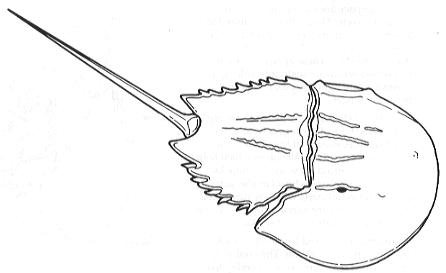
HORSESHOE CRAB
- Arachnids
* Terrestrial
* Eight legs
* Chelicerae or fangs with venom
* Ocelli
* No antenna
* Breathe by book lungs &/or tracheal tubes
- Spiders
* Arachnid that feeds on insects (carnivores)
* Have oval shaped, unsegmented abdomen
* Cephalothorax connected by narrow waist to abdomen
* Have 8 simple eyes or ocelli
* Fangs pierce prey, inject poison, & suck out body fluids
* Pedipalps on head help sense prey & move it to the mouth
* Open circulatory system
* Ostia are openings in heart where blood reenters
* Body cavity called hemocoel
* Hemocycanin is oxygen-carrying pigment in blood
* Have silk glands to make silk & spinnerets to release silk for webs
* Breathe by book lungs & tracheal tubes
* Malpighian tubules filter wastes & reabsorb water

GARDEN SPIDER
- Ticks & Mites
* Parasitic arachnid
* Fused cephalothorax & abdomen
* Most abundant arachnid
* Need blood meal to molt
* Mites can damage fruit & feed on dead skin at base of hair follicle
* Ticks carry Lyme disease & Rocky Mountain Spotted Fever
 MITE |
 TICK |
- Scorpions
* Have a cephalothorax & long segmented abdomen curled over body
* Prefer dry regions
* Poisonous stinger on end of abdomen
* Breathe through book lungs
* Pedipalps modified into claws
* Nocturnal predators

SCORPION
Subphylum Crustacea
Characteristics
- Marine members include shrimp, lobster, copepods, barnacles, & crabs
 |
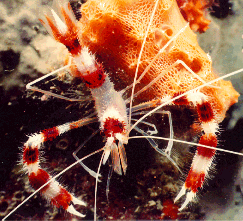 |
| CRAB | SHRIMP |
- Terrestrial crustaceans called isopods include pillbugs & sowbugs
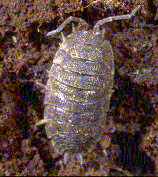
PILLBUG
- Freshwater members include crayfish & Daphnia (water fleas)
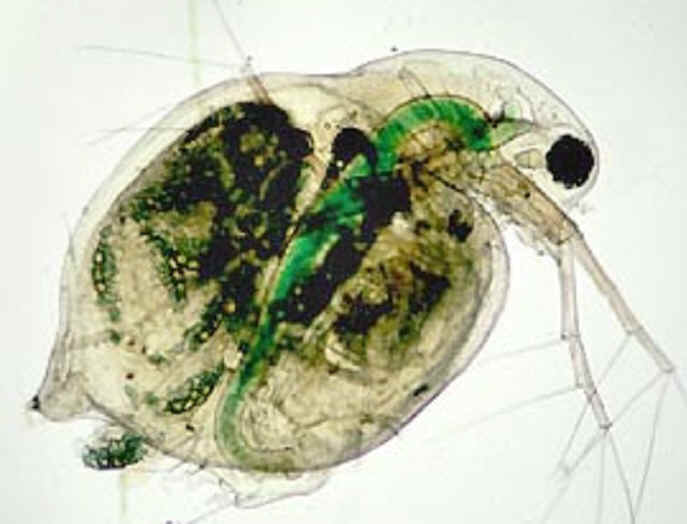
DAPHNIA
- All have jaws are mandibles for chewing or tearing
- Known as mandibulates
- Have cephalothorax & abdomen
- Have 10 pairs of jointed appendages
- Breathe through gills
- Barnacles
* Marine
* Sessile crustaceans that live in limestone case
* Filter plankton with 12 appendages called cirri
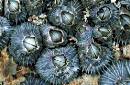
BARNACLE
- Isopods (pillbugs & sowbugs)
* Live on land in dark places
* Have 7 pairs of legs on a segmented body
* Can roll into a ball for protection - Crayfish
* Cephalothorax made of 13 fused segments & covered by protective carapace
* Antennules located on head help in balance, touch, & taste
* Statocysts – balancing organs at the base of antennules
* Antenna on head used for touch & taste
* Maxillae – paired mouthparts that move side to side to tear food
* Maxillipeds – help hold food
* Chelipeds – claws used to capture food & for protection
* Mandibles – jaws that move up & down to crush food
* Walking legs – 8 pairs used for movement
* Swimmerets – under abdomen to swim, gas exchange, & protect eggs/young
* Abdomen ends in flat segment called telson with flat uropods on each side
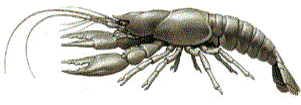
CRAYFISH
* Compound eyes on stalks
* Chitinous teeth in stomach grind food
* Wastes leave through anus
* Green glands filter wastes from blood & help with salt balance
* Open circulatory system with heart to pump blood to gills & body cells
* Ostia – one way valves allowing blood from dorsal sinus to reenter heart
* Gills attached to walking legs
* Separate sexes that mate in fall & sperm stored in seminal receptacle
* Eggs attach to swimmerets of female & hatch in several weeks
- Copepods
* Largest group of crustaceans
* Make up most of the marine plankton
* Serve as food for many marine animals
* Found in freshwater, marine, & moist terrestrial environments
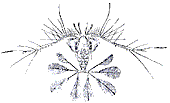
COPEPOD
Subphylum Uniramia
Characteristics
- All have antenna, mandibles (jaws), & unbranched appendages
- Includes 3 classes — Chilopoda (centipedes), Diplopoda (millipedes), & Insecta
- Known as myriapods
- Most are terrestrial
- Exoskeleton prevents desiccation (water loss)
Class Chilopoda
- Terrestrial centipedes
- Flattened body with longer legs for fast movement
- Have 1 pair of legs per body segment
- Predators
- Mandibles & maxilla for chewing prey (insects & earthworms)
- Claw-like appendages or pincers on 1st body segment that can inject venom
- Can coil up for defense
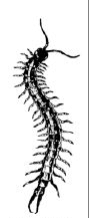
CENTIPEDE
Class Diplopoda
- Terrestrial millipedes
- Have 2 pairs of legs per body segment
- Rounded body
- Scavengers on decaying vegetation as they burrow through soil
- Roll into ball when threatened & spray noxious chemical containing cyanide

MILLIPEDE